
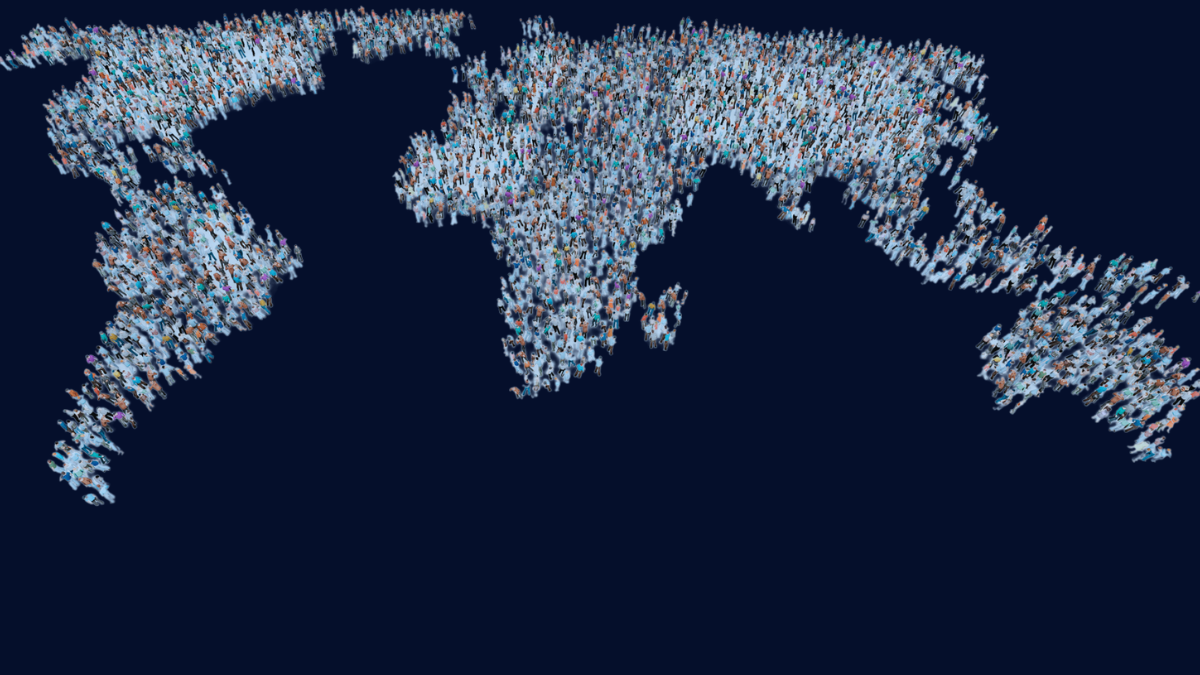
The rare disease singularity
Four capabilities converged. Cures are reachable.
In 2003, sequencing a human genome cost approximately three billion dollars. In 2026, a parent can order a whole-genome read for under two hundred dollars from a consumer provider and have results in days. Seven orders of magnitude.1
A similar trajectory ran in AI. A pattern-recognition task that required a research team and dedicated hardware in 2010 runs on a consumer device in 2026. A correlation that took a graduate student a summer to surface from spreadsheet data can be queried from a phone in seconds.
A similar trajectory ran in compliance. Zero-knowledge proofs were formalized in academic cryptography in 1985 and are production-ready in 2026. A sponsor can verify a research question against a cohort without ever seeing the cohort.2
A similar trajectory ran in regulation. The FDA published its Real-World Evidence Framework in 2018 under authority granted by the 21st Century Cures Act. Contributor-generated data is a legitimate input to regulatory decisions.3
These four capabilities arrived independently. None required the others to be invented. None required the rare disease community to advocate for them. Each was a major engineering and policy effort that took years.
They have converged.
The convergence is the rare disease singularity.
What a singularity is, in this context
Singularity here is borrowed from technology forecasting, where it names the moment when accumulated capability passes a threshold that changes what is possible. The rare disease singularity is not a forecast of artificial general intelligence. It is the present convergence of four specific capabilities that together change what a rare disease community can do.
Before the convergence, four binding constraints structured the rare disease economy. Genome cost was a barrier to population-scale rare disease data. AI capability was a barrier to deriving meaning from rare disease data. Compliance and privacy were barriers to using rare disease data lawfully. Regulatory acceptance was a barrier to translating rare disease data into approved decisions.
Each constraint has now lifted. None is the binding limit anymore.
When the binding constraints lift, what was impossible becomes possible.
What the singularity makes possible
The contributor can do work that produces their own benefit while they are still alive.
A PKU family in 2029 can have a home biosensor that reads phenylalanine in three minutes, with a seven-day trend overlaid against the kid's mood log and school performance. The variant-specific cohort data the trust derived from contributors feeds this overlay. The feedback loop the family ran on a two-week filter-card cycle for forty-three years closes inside one daily life.
An EDS adult in 2028 can have an adult metabolic or connective-tissue specialty clinic to age into, because a clinician read a Cureledger Authority piece in 2026 and built the practice that now serves rare disease adults in the region. The demand case was made through cohort proofs from contributor data.
A child with an n-of-1 variant in 2027 can be matched to a treatment because the variant signature was identified across three contributors in different states, none of whom would have found each other through the registry system, and a cohort proof was licensed to a biotech that pivoted its program.
These are not promises. They are the operating mechanism the singularity makes available. None of them require AI miracles. They require basic pattern recognition, contributor-owned data infrastructure, and cohort-proof licensing, all of which exist in 2026.
Why now is different
The previous era's rare disease story ran on the assumption that the contributor would supply the data and the system would, eventually, return value. That assumption was reasonable in 1965, when the Guthrie test was being deployed at scale and the alternative for undiagnosed PKU was preventable brain damage. It remained reasonable in 1996, when HIPAA was passed and the privacy framework was a paper trail because no other framework was buildable. It remained reasonable in 2010, when AI was emerging but expensive.
It is no longer reasonable in 2026.
The contributor can keep the data, license cohort proofs, share in the revenue, see the variant-specific outcomes, and access the feedback loop that the contributor's own data produces. The architecture is built. Vault and contracts are live this month.
The rare disease singularity is not a future state. It is the present moment. Patient cohorts can act now to capture the benefit while they are still alive.
What this means for the contributor
Three things.
First, the time to wait for institutional retooling is over. The architecture is available now. The trust, the cohort proofs, the vault, and the contracts are live this month. The contributor does not have to wait for a foundation or a registry to retool around them.
Second, contemporaneous benefit is the design goal. The trust is not designed to return value to the field in twenty years. It is designed to return value to the contributor in the contributor's lifetime.
Third, the contributor's role is operator, not passive subject. The architecture only works when contributors govern their data. The trust is for the contributor's benefit by legal structure.
What this means for the institution
The capabilities that made the old architecture defensible are no longer the binding constraints. The institutions that retool first capture the leadership position in the next generation of rare disease care, research, and product. The institutions that hold onto the legacy posture will be the institutions trust beneficiaries route around.
This is operational, not adversarial. The trust does not argue institutions down. It builds the architecture institutions can integrate with, or compete against.
The car is built
The convergence is real. The capabilities are present. The architecture is live.
Patient cohorts can act now to capture the benefit while they are still alive.
The work has fallen to us. We are doing it.
Notes
-
National Human Genome Research Institute. The Cost of Sequencing a Human Genome. https://www.genome.gov/about-genomics/fact-sheets/Sequencing-Human-Genome-cost ↩
-
Shafi Goldwasser, Silvio Micali, Charles Rackoff. The Knowledge Complexity of Interactive Proof Systems. SIAM Journal on Computing, 1989. Paper first presented at STOC 1985. ↩
-
U.S. Food and Drug Administration. Framework for FDA's Real-World Evidence Program. December 2018. https://www.fda.gov/media/120060/download ↩